Review: Pepeha Portal, by Ariana Tikao
'Words and the perception of words, their supposed meanings, are vast open landscapes, depending on how the light hits them...'
Kāi Tahu Arts Laureate Ariana Tikao’s debut poetry collection Pepeha Portal begins with an interpretation of the meaning of pepeha. As a title on its own page, pepeha is defined as ‘a set of words, a figure of speech, a boast’. I understood pepeha to translate to a citing of one’s lineage, a listing of ancestors. Tikao’s definition sets the stage for an entirely different understanding, making the word resound like the thud of a deep drum at the start of a play. In the preceding poems she goes on to indicate the scope of this singular word in her hands.
The opening phrases of the first poem ‘Mihi’ (or ‘Welcome’) juxtapose each other similarly, introducing the very nature of Tikao’s collection: that the concept of the past and the future are not separate entities in the world of te aō Māori. The author paints these contrasting worlds with grace and fluency. Words and the perception of words, their supposed meanings, are vast open landscapes, depending on how the light hits them. They are places to explore and traverse. They are also cloistered, secret spaces, always tunnelling back to tūpuna.
Further on in the collection, the idea of a portal is introduced. Set alone on a pale page the word portal is defined as ‘a doorway, a gate, an opening between realms.’
In this place between worlds we see the real beauty of two time frames colliding, becoming one contemporary being. The book design supports this concept masterfully, past informing the present, a constant breathing down the neck of the future. Tikao finds this a deeply grounded place, in the friction of the ancients, the ominous throb of an AI centre, and the smoke of a decimated Gaza (referenced in several poems ‘Settling’ and ‘Kua Whetūrakitia’).
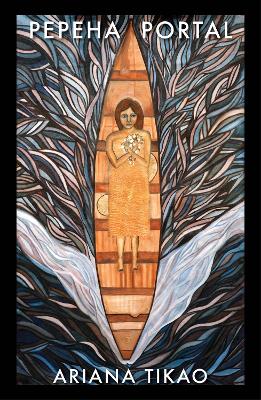
Reading a collection of poetry in one swoop feels to me like eating a whole box of cereal at one sitting. I prefer to take most collections more obliquely, and so Pepeha Portal travelled with me and my children for a few weeks, on the bus, the ferry, and the playground, garnering attention wherever we were. At a bus stop I asked a young woman with long dreadlocks who was eyeing up the cover painting (of a woman in a small waka holding flowers, by Kate Stevens West (Kāi Tahu)) if her reo was better than mine. Could she tell me about Rūaimoko, a figure who appears in the opening poem ‘Mihi’?
‘Oh my reo’s a bit rusty,’ she said, but what she told me about Rūaimoko was a poem in itself, referencing what her nanny had told her about the demi-god. ‘Rūaimoko is the god of earthquakes and he was still inside when Rangi and Papa were pushed apart.’ Tikao captures the essence similarly: ‘When Rūaimoko turned again in the womb, a rock the size of a small car tumbled down your slope.’ An ancient meeting the prospect of a modern small car conjures an unusual and arresting image.
Fostered by this new knowledge, ‘Mihi’ took on a new meaning, as does ‘Head Red’ or ‘Erosion’ where the author’s place of residence (Ōtautahi) has been beset by earthquakes. Māori words and Pākehā intermingle and grace each other forming a new world, one that is deeply readable. In ‘Lizard Motel’ Tikao meanders through a multitude of interpretations about native lizards and the destruction of their habitat. A giving over of their whenua ‘so billionaires can receive courier parcels delivered by rocket to their underground bunkers in Central Otago’ or ‘what will the lizards think of the launch site just down the spit from their lizard motels?’
It is a considered, cohesive collection, challenging non-speakers to improve their reo, asking questions about a deeper view of the custodianship of the Māori world, demanding second and third readings. More than once I found myself revisiting traditional Māori myths and motifs and re-reading the same words with a deeper understanding on hand. The very unfolding of meanings and backstory to certain Māori words open smaller doors themselves, forming an intricate pattern of words and worlds.
It is a collection worth taking your time with, revisiting again and again. Or as Tikao says in ‘Intonation (for the late Moana Jackson)’ ‘ like light emanating from glow worms / Come in closer, lean on in’. It’s a taonga.
Claris Harvey (Ngā Puhi) is a writer and producer from Waitākere. Her story 'The Golden Glove' won the national flash fiction prize in 2025 and her poems have been featured as part of National Poetry Day. She is the descendant of Māori Roman Catholics, British sailors and Azorean whalers.