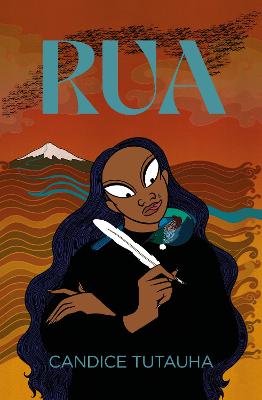
Review: Rua, by Candice Tutauha
'Her sixteen-year-old protagonist navigating rickets and living on a state hand-out is a far cry from the caricatures of benefit bludgers and crime syndicates that politicians would lead you to expect of her community...'
On the November 2nd edition of The Hui, political commentator and long time media mogul Carmen Parahi synthesized the year’s election in one simple word: desperate.
I think there no better example of this than the relentless back-and-forth by politicians on the moral politics of gangs. In what was an insidious three week media cycle, Te Pāti Māori and Green MP’s were criticised heavily for campaigning at a gang pad. Strangely, it wasn’t until past photos resurfaced of former Prime Minister John Key posing with gang members that the storm settled. But by then the damage was done.
The behaviour leaves one asking: Are we truly trying to solve the gang issues or have we found a convenient pet issue for a slow news day or an uninspiring political race?
Candice Tutauha enters this debate with her hand on the pen, putting her lived nuance to work. Her debut novel Rua arrives just at the right time, as we’ve all hit a political and cultural fork in the road.
Opening on the eve before a big party, Rua is a coming-of-age story set in a not too distant moment during the turn of the twenty-first century. Reading like a memoir, it inhabits the hardship and displacement experienced by urbanised Indigenous people following the second greatest migration in Māori history, the Urban Drift.
Rua is named after its titular main character. A young woman whose life resembles the political football that parliament hopefuls blithely kick for votes. In an under-resourced neighbourhood marred by gang violence, drugs, and a deep spiritual rut, Rua embodies the fierce resilience of a young woman striving to rise above her circumstances against all odds.
Tutauha writes with a gritty realism reminiscent of an Alan Duff novel. Unsurprisingly, the narrative is often deeply confronting, with raw hardship woven throughout every chapter. Yet her sixteen-year-old protagonist navigating rickets and living on a state hand-out is a far cry from the caricatures of benefit bludgers and crime syndicates that politicians would lead you to expect of her community.
The hand dealt to Rua seems like a run of bad luck, at first. A terrible fate where family members connect over shared drug use, where people fall to a drunk stupor on the street, and where gang members exude their fearsome presence over the neighbourhood. It all appears like a peek into her own doomed future.
Until one day when she is given the diary of Major Gustavus von Tempsky during the Taranaki wars. Using those land wars as a historical mirror, Rua comes to realise that the calamity hurting her people were never failures in pure isolation. So as we witness a sweet neighbourhood crush turn to gang prospecting or a Rastafarian cousin hack at his dreaded tresses marking a spiritual demise, we also come to realise the long ranging consequences of colonisation.
These choices, which might seem extreme or incomprehensible to the average middle-class observer, are the natural inheritance of those living in the long shadow of von Tempsky’s war.
In holding both the past and the present the narrative occasionally moves at a break neck speed, leaving a few secondary character arcs feeling abruptly truncated. However, where Rua excels as a novel is in its refusal to wallow strictly in tragedy. Tutauha balances the heavy themes of systemic grinding with moments of warmth, dark humor, and authentic whānau connection. Her prose is strikingly referential, quoting Shakespeare and Tupac Shakur in the exact same breath. And her writing moves with a unique, urgent cadence, capturing the sepia-toned warmth of this Whanganui cul-de-sac found only in old family albums.
Ralph Waldo Emerson said in a poem that one's opinion of the world is also a confession of character. The cynical gang panic that played out through parliament and the media recently reveals or confesses a deep fear of structural accountability. Whereas Tutauha’s Rua, by contrast, shows a profound empathy. It is a story that not only exposes a reality rarely given honest airtime, but honors the gumption required to stand up, break a cycle, and redirect a whānau’s destiny.