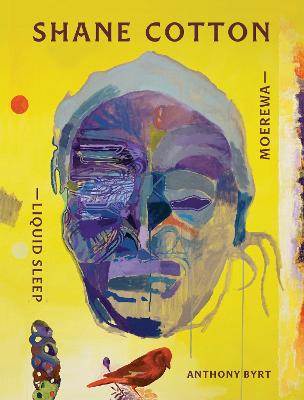
Review: Shane Cotton: Moerewa — Liquid Sleep, by Anthony Byrt
'With Byrt as guide, we feel the full heft of Cotton's work. He takes us back to where the paintings begin...'
Shane Cotton (Ngāpuhi, Ngāti Rangi, Ngāti Hine, Te Uri Taniwha) is a defining figure in the contemporary New Zealand art world, and Anthony Byrt is one of its most engaging writers. Shane Cotton: Moerewa — Liquid Sleep brings them together - an intriguing pairing.
Byrt has thought hard about how to write an artist's life. In a 2018 review, he diagnosed a 'biography problem' in New Zealand art history: we tend to trace the paintings and ideas that shaped our artists but forget how they lived. This habit, he argued, lets our best artists down, throwing a blanket over 'the fires' that produced their work. In The Mirror Steamed Over (2020), he met his own challenge, showing how the tangled lives of Billy Apple, David Hockney and Ann Quin fed the art of early-sixties London. But that was history, viewed from sixty years' distance. Could he write as truly about an artist still living, still at work?
Byrt's answer is to work alongside his subject – to listen, to discuss, to defer. The book came out of more than a decade of studio conversations and shared journeys through Te Tai Tokerau. Cotton grew up in Upper Hutt, spending long stretches with his grandparents in Moerewa; in 2019 he moved north for good. Moerewa, in one telling, takes its name from an ancestor who crossed from Hawaiki as water, in a 'liquid sleep'. Byrt, too, has whakapapa in the North, to Ngāti Kahu ki Whangaroa, and descends from Dalmatian gumdiggers. But he steps into the book only occasionally, as a travelling companion rather than front of the story.
More than 150 handsome reproductions show the sweep of Cotton's work, from the sepia-toned Whakapiri Atu te Whenua (1993) to the saturated, celestial blue of Te Waiwhāriki (2005) and the 'technicolour weirdness' of Super Radiance (2024). There are spreads, too, of his patterned baseball bats and 'gang patch' paintings. As a book of images alone, it would be reward enough.
But with Byrt as guide, we feel the full heft of Cotton's work. He takes us back to where the paintings begin: a single, far-reaching upheaval, the meeting of Māori and British worlds in Te Tai Tokerau, 'a place full of sensuality, rage, conflicts, brilliance and broken covenants'. He tells of the missionary Thomas Kendall, who 'spent his life trying to escape himself', and of the 'toxic and devastating synergy' between him and the Ngāpuhi rangatira Hongi Hika, whose musket raids of the 1820s killed thousands. All of this is in the art, with Hongi often at its centre: his bust recurs, as do the inscribed, preserved heads traded in the same decade. Depicting the heads is contentious – Cotton knows he is 'playing with fire' – but he refuses to look away. For him the heads, severed and scattered through the world's museums, embody the upheaval itself. Their long exile is its own kind of liquid sleep.
Byrt moves through all this lightly, alive to the 'dizzying, culture-defining energy' these figures give Cotton's art. He follows everything that seeps into the paintings: the Bible in te reo, Ngāpuhi histories, missionary journals, science fiction, even PlayStation games. In a quietly unsettling chapter, Byrt uses Cotton's paintings to draw a line from Penetana Papahurihia, the northern prophet whose Māori reading of the Bible so alarmed the missionaries, to the Māori gangs of the 1970s, many formed by young men damaged as children in state care. To Cotton, prophet and gangs alike were renegades who turned the colonial world upside down.
This is not a conventional biography, and it doesn't pretend to be. There's little of Cotton's early life (we meet him at art school), or of his doubts as an artist: the 'mess of ordinary lives' Byrt himself wrote of in 2018. But there is more than one way to get to an artist, and Byrt's choice is right: Cotton's fires are historical, not private. In his painted universe, time is not a line but 'a constellation or series of points'; 'everything is always on the way to being something else'. Byrt lets the paintings set the course, folding 1814 into 2009, Hongi and Kendall into the canvas. A childhood would only have pinned it down. In answering his own question, Byrt has made something rare: a book about a living artist that keeps the conversation open and the work in motion.
There's a charge pulsing through Cotton's work, and in his closing pages Byrt finds its source: the artist's willingness to let opposing forces stand unresolved. For Cotton, and for Byrt, biculturalism is 'a cultural reciprocity so taut that it vibrates through every aspect of Aotearoa's collective body like a sub-atomic force'. It should never be stilled, and neither man tries.