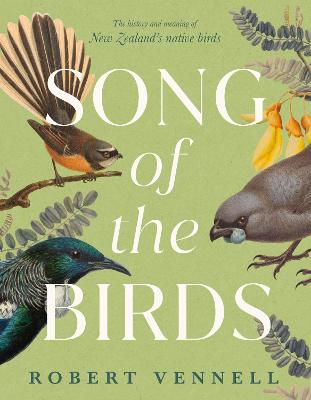
Review: Song of the Birds, by Robert Vennell
'A historical tour of New Zealand’s native manu from the time before people set foot on the shore through to the present day.'
Robert Vennell’s latest book Songs of the Birds takes you on a historical tour of New Zealand’s native manu from the time before people set foot on the shore through to the present day. The introduction conjures up an incredible prehistoric dawn chorus: the first rays of sun peaking over the horizon are like the waving of a conductor’s baton summoning the chimes of hundreds of tiny bells. The song of the korimako then bursts forth from the forest, with the blending in of the kōkako’s haunting symphony, the sweet notes of the riroriro’s warble, the piping of the robin, the tui’s tenor, the beautiful flute-like melody of the piopio, and the love duet of the huia until the sound drowns out even the crashing of the waves.
New Zealand has long been known as a land of birds with written records describing our avian fauna dating back to 1769 and the first book about them, authored by Walter Buller, appearing in 1873. But before the written word there was the tradition of Māori pūrākau, oral stories told from generation to generation that explained the place of birds in the natural world, and whakataukī, proverbs or sayings seeking to explain something using an avian example. In Songs of the Birds: The history and meaning of New Zealand native birds Vennell weaves together the legends, the sayings and the early written accounts to create a story unique from any other publication about the birds of Aotearoa.
In his bestselling book The Meaning of Trees Vennell was said by one reviewer to ‘make wandering through our bush seem like a visit to a giant shopping centre.’ Secrets of the Sea, a finalist in the Ockham New Zealand Book Awards, waxed lyrical about kaimoana. In Songs of the Birds Vennell has once again scoured through the dusty archives to describe the use of birds as medicine; tools; clothing; symbols of status; and lastly food, including historical anecdotes of the different flavours!
As with all of Vennell’s books the cover of Songs of the Birds gives it an olde world vibe, and many of the images that grace the luxuriously thick pages of the book date from the historical, often reproductions of original paintings by the incredibly talented Johannes Keulemans, who illustrated Buller’s 1873 A History of the Birds of New Zealand. The modern touch is provided with wonderful stills by freelance photographer Matthew Cattin, who Vennell credits as having travelled from one end of the country to the other perching on mountain peaks and sleeping out in swamps searching for the perfect shot.
One regret I have with this book is that it is not twice as thick. I would happily have read legends and whakataukī about all of our birds, past and present. Vennell has had the unenviable task of deciding which manu to include and which to leave out of the pages. Dividing the book into seven sections - Songsters, Grazers, Bush Kai, Hunters, Swamp Creatures, Voyagers and Guardians - Vennell tells tales about 34 avian species. The book includes pūrākau about birds that are sadly now extinct like the moa, koreke (native quail), whēkau (laughing owl), and piopio. Then there are the success stories about the birds that, through good old Kiwi (the people this time) ingenuity, have been brought back from the edge of the extinction precipice including the takahē, kākāpo, tīeke and hihi. While names such as kea, kiwi, and kāhu will be familiar, many of the stories about these birds will be new and all are written in Vennell’s very readable and comprehensive style.
According to Vennell’s research a whakataukī about the toutouwai says ‘Kua rarahi ngā mata ō te tōtōra’ which translates as ‘The eyes of the robin are opening’ to signal that the sun was beginning to set, but it was also used to describe someone who was able to see more clearly about something. May Songs of the Birds open your eyes to another way of viewing the manu of Aotearoa.