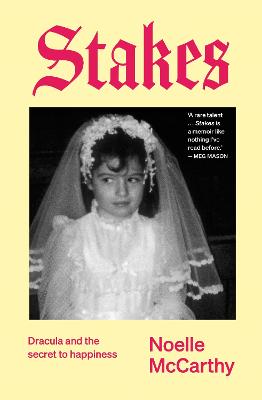
Review: Stakes, by Noelle McCarthy
'This is a book about chasing desire, but also about renegotiating boundaries...'
Noelle McCarthy is obsessed with Dracula. It began when she was a young girl in Ireland, opening her bedroom window at night to invite Dracula in. The fascination followed her through her teenage years and into her twenties, as she explored Dracula in university essays and her master’s research. But it’s deeper than that. Dracula is so interwoven with McCarthy’s life that it’s difficult to separate where the story of Dracula ends and hers begins.
Stakes is McCarthy’s second book, following her award-winning debut, Grand. In her author’s note, she states, ‘Vampires show us our fears and our wants, the parts of ourselves that would do the most damage if you gave them their head.’ It’s through this lens that McCarthy invites us into her life, showing us the raw entanglements with darkness she’s lived through.
We follow McCarthy as a teenager discovering the excitement and danger of boys. We meet her again in her messy twenties and thirties in Auckland, dating married men and seeking safety in three bottles of wine. Finally, we encounter McCarthy in her forties, tackling sobriety, motherhood, grief, and reckoning with the maternal lineage she inherited.
This is a book about chasing desire, but also about renegotiating boundaries once its consequences become impossible to ignore. As McCarthy writes, ‘Vampires don’t like boundaries, but they are forced to respect them.’ We’re repeatedly dropped into the grey areas of the author’s experience: when drinking tips from socially acceptable to a coping mechanism, revealing that ‘…rock bottom isn’t one day. You can bounce along the bottom for a long time.’
McCarthy also explores moments when sexual consent isn’t always clear. This is where the memoir is especially affecting, not only in her own life but also in the lives of women throughout history, including in the wake of #MeToo. In a standout scene between McCarthy and her then fiancé, John, the two struggle to understand each other’s perspective. ‘Every woman knows about this…We all have stories,’ she says. ‘It’s happening right now…a woman having sex she doesn’t want, with some man.’ John replies, ‘That’s rape, though.’ She counters, ‘It isn’t always. Rape, I mean. You can consent without necessarily wanting to have sex.’ It’s this nuance, this murky middle ground, that McCarthy is determined to understand for herself and reveal to the reader. This, too, is Dracula at work. The author describes him as ‘a sex monster’ who will ‘take what he wants, whether you like it or not.’
McCarthy doesn’t hide on the page. She’s brutally candid, conversational, and forthcoming. That willingness to bare herself, in both the best and worst light, builds trust with readers. Scenes that, in less capable hands, might have been difficult to read, instead deepen our understanding and move the narrative forward with care, intention, and a healthy dose of humour.
Thirty years after initially inviting Dracula through her childhood window, McCarthy declares, ‘He never came.’ This is the one point where I’d disagree. I’d suggest Stakes is proof that Dracula did indeed come for her. She’s spent her life tangled in the darkness of everything Dracula represents: addiction, grief, sexual transgression, temptation, and shame. I’d even argue Dracula’s influence runs deeper than McCarthy’s story. It’s an inherited legacy passed through her maternal line. Her mother and grandmother wrestled with these same forces too, along with many women growing up in Catholic Ireland. McCarthy is trying to make sense of their lives as well as her own. She does a brilliant job of showing us that Dracula did come in through that window, and perhaps never really left.
Stakes is an honest, unflinching examination of a life lived between what’s good for us and what we desire. Even though McCarthy writes, ‘Dracula is a story that tells the truth about how everything is going to rot eventually,’ she’s found a way through a darkness that is always there, ebbing and flowing. It will challenge readers to look at their own lives, to reflect on the darkness that lies within all of us, and to reckon with our own encounters with Dracula.