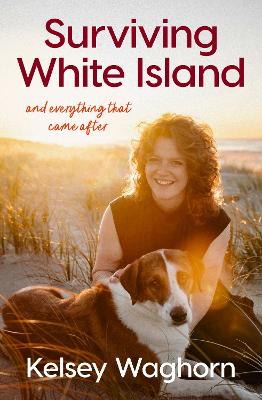
Review: Surviving White Island, by Kelsey Waghorn
Angela Walker reviews Kelsey Waghorn's SURVIVING WHITE ISLAND, a story of persistence and grit.
Kelsey Waghorn has taken tour groups to Whakaari White Island hundreds of times. But nothing prepares her for the ordeal of being on the island when it erupts in 2019 – or the harrowing aftermath she endures, physically and mentally, for years.
With burns to 45% of her body, Kelsey experiences countless operations, skin graft surgeries, relentless pain, rolling infections, survivor guilt and debilitating PTSD. Yet she shows it’s possible to survive a pyroclastic surge, and ultimately prevail – just.
It’s best not to describe Surviving White Island as Kelsey’s journey – she hates that word. Rather, the book is a collection of recollections – and not just her own. It also captures real-time reflections from her support team: her mum, dad, sister, partner, and other members of her whānau, along with the doctors and nurses who painstakingly rebuild her. These multiple perspectives have been stitched together from daily records kept at the time.
The story is divided into three sections, with Part I detailing Kelsey’s early years and work as a guide with White Island Tours. For the most part, she’s a fun-loving, feisty young woman who thrives on her ocean-going job to the geothermal wonderland. However, near-death experiences come with the job, it seems, foreshadowing what lies ahead. When she visits Whakaari the day it erupts, everything changes in an instant: 'It was a normal day until it wasn’t…'
Kelsey’s shocking survivor account of that ill-fated December afternoon is the first to be included in a memoir. Fortunately, her safety training and knowledge kick in the moment the island breathes an almighty ash-grey plume into the sky. After sheltering behind boulders, she manages to guide her group back to the boat while their body parts are melting. During the torturous hour-long return to Whakatāne, the uninjured come to their aid onboard: 'They spoke to us, sang to us, asked us questions, trying to distract us, to reassure us – all with fear in their eyes.'
Part II tells the story of Kelsey’s months in hospital navigating life-threatening injuries. At first glance, the structure suggests a disjointed read. Kelsey was too incapacitated at the time to be able to retell this part herself. Instead, she shares a compilation of messages and notes. There are family 'group chats' and entries from 'The Red Book' – a daily diary created by an ingenious ICU nurse for family and medical staff to write in. There’s also a layer of footnotes where Kelsey belatedly chimes in with extra details and comments. Somehow, despite the fragmented approach, it all weaves together to create a compelling narrative, offering a rare insight into the nightmare faced by burns victims and their families.
The years following Kelsey’s discharge from hospital are even more fraught. In one aptly titled chapter in Part III – ‘You thought that was bad?’ – she admits her delayed-onset mental breakdown was worse than any previous horrors: 'It turned out the physical part was the easy part,' she writes.
Having eventually clawed her way out of the deepest of holes, she wants us to know she’s not special. Her message is one of perseverance. 'I want to show you one important thing: life gets infinitely better if you keep trying,' she writes, having almost not withstood the temptation to give up.
There are plenty of harrowing moments in Kelsey’s story, yet it’s not as confronting a read as the title may suggest. Her endearing and distinctive voice, her honesty, bravery and sense of humour, plus the aroha surrounding her make for an uplifting tale at times. Yes, she endures things no-one should surely ever have to. But along with it we witness acceptance, gratitude, personal growth, tenacity and hope – and the phenomenal support of a family whose lives have been upended, too. Kelsey’s mother, in particular, is a reminder of the power of encouragement and unconditional love.
Surviving White Island also underscores the way doctors and nurses keep people alive against the odds, unsung heroes in our midst. In telling her story, Kelsey has shone a spotlight on their critical, behind-the-scenes work. She owes them her life and now she’d do anything for them. 'You want to use photos of my grafts healing? Done. You want to use me as a case study? Absolutely. You want me to speak at your event? I’ll clear my calendar.'
Now that she’s shared her uncommon story with such candour and generosity, her calendar is likely to be in demand for some time.