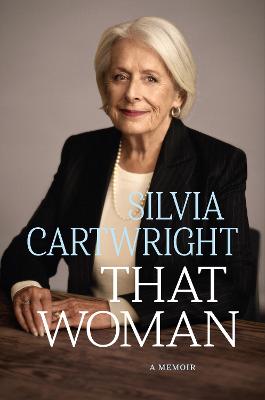
Review: That Woman, by Dame Silvia Cartwright
'I hadn't expected the subversive wit. 'I have an unfortunate tendency to recount the funny side,' she says...'
Just about everyone in NZ has heard of Silvia Cartwright. She's an almost Renaissance figure, intellectually expansive, compassionate and courageous in controversial issues, modestly patrician in bearing.
This elegant, incisive memoir traces a career that's exceptional even in the briefest summary. First woman in the country appointed as a High Court Judge; chair of the eponymous enquiry into cervical cancer at National Women's Hospital; member of the UN Commission to eliminate discrimination against women; Governor General; recipient – sometimes reluctantly – of multiple honours; UN Trial Judge in Cambodia; chair of still more enquiries.
It all started in Dunedin, with an affectionate childhood splintered by her admirable father's financial crises. (She's been an obsessively instant bill-payer ever since.) She struggled financially and academically at the start of her University law studies, prompting a pair of fellow students to suggest she was just there to find a husband. Later, she was told she got her law clerk job only because she had the best legs. Dame Silvia, I apologise on behalf of my gender.
But she starts advancing in her career, always assisted by husband Peter, right from the moment he tells her that no, it isn't a Pimms she wants to drink.
There are cogent summaries of cases in which she was involved as a young lawyer – involved emotionally and ethically as well as professionally. Almost emblematically, one of the first is a young mother, stricken with post-natal depression, accused of murdering her baby.
Cartwright watches approvingly through the 1970s as 'the feminist movement became turbo-charged', and assumptions about matrimonial property, custody, sexual abuse, abortion are all challenged. She still has to endure male pomposity: a judge informs her that her skirt is too short; the robing room at court is for men only (women use the toilet, please).
She's appointed to the High Court, and takes on the famous, notorious enquiry into procedures at National Women's Hospital. At first she's almost light-hearted – 'a marvellous break from all these paternity cases' – but soon appalled at the 'Doctor God' culture. She writes unflinchingly of elitism and distress; arrogance and powerlessness. The book's title is explained. A mordant humour flickers; I refer you to the goldfish-naming competition.
Other cases also distress her. Extracts from her judgements are models of clarity while hinting at the agonies involved. Of one case involving a dreadfully-afflicted newborn child, she admits 'even now, as I write this, I am tearful'.
She's made Governor-General. At Buckingham Palace, for an audience with the Queen, she and Peter hear corgis barking as they ascend in a lift. Then a voice yells 'Shuddup!'. Nice.
I hadn't expected the subversive wit. 'I have an unfortunate tendency to recount the funny side,' she says. Actually, ma'am, it's a fortunate tendency, and it starts glinting from page one, where she assesses the claim by a Cambodian leader of his miraculous birth in a flash of light from a banyan tree. Later, she'll neatly skewer the 'privileged, entitled' male colleague found dancing naked in a fountain just before his wedding. She even manages a smile at the occasional misrendering of her first name as 'Saliva'.
Some events are too dark for humour. Cartwright spends eight years as a UN Trial Judge hearing evidence on Cambodia war crimes. It was 'a difficult ethical environment': the numbing atrocities and the ambivalent response by some individuals and governments. Again, she tellingly uses individual narratives to evoke the horrors: the talented mathematician who was forced to lead a Khmer Rouge torture prison.
Peter dwindles, then dies. It's related quietly, affectingly. Cartwright herself goes on. You feel she always will. She serves on the Christchurch Earthquake Commission, the Dilworth School abuse enquiry, and helps with the International Court of Justice's investigation into North Korean prisons. The Epilogue is an affectionate account of her friendship with Māori Queen Te Ata, and Te Ata's son, the late Kīngi Tūheitia.
It's a book flecked with famous/infamous names; sometimes reads like a Who's / Was Who of prominent persons in NZ and world-wide. Cartwright doesn't hold back; some of the cast won't be thrilled at the ways their attitudes and behaviours are recorded. Serves them right.
A stylish, unflinching, always engaging personal history. I have to mention how the author has already been asked by our Cabinet Secretary what sort of funeral she would like. Mischievously, she asked that it include a riderless black horse.
Rodgers and Hammerstein presciently wrote, 'There is nothing like a Dame'. Especially this one. Multiple thanks, Dame S.