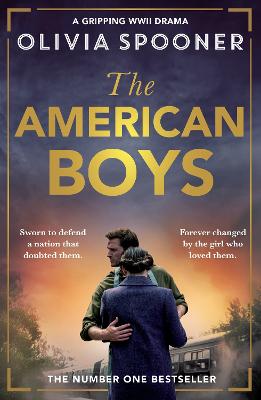
Review: The American Boys, by Olivia Spooner
'The American Boys is more compelling as a love letter to Kiwi women and how they upheld domestic and industrial responsibilities despite being told that their place would only be temporary...'
Wellington, 1942. Twenty thousand American soldiers are sent to Aotearoa to protect its inhabitants against a potential attack from Japan while its own are fighting abroad.
The latest from the author of bestselling novels The Girl from London and The Songbirds of Venice, The American Boys by Olivia Spooner is a wartime drama from the homefront. Told from the viewpoints of Lorna, Stan and Alfie, the narrative follows the transformation of the capital city when thousands of Marines are posted to protect New Zealand against a possible attack.
Setting is strong in this book. Wartime Wellington is captured perfectly in its drab, Victorian-architecture glory. The wind, cold, and sea are all constant presences alongside our main characters.
The main protagonist, Lorna Baxter, is an intelligent girl in her late teens who would rather not think about boys or going to dances. She works in the munitions factory with her best friend Karen and lives at home with her parents and younger brother, Peter, on Ranui Street – a fictional street, but one that will be recognisable to most.
Lorna meets Stan, a handsome, blond Marine from Chicago, at a rugby game. Both keen on sport, they hit it off. Lorna explains rugby to Stan, and he teaches her the jitterbug.
Months later, Stan’s younger brother Alfie joins the forces stationed in Wellington and tension ensues.
When the Marines land in Wellington’s harbour, the more demure and less excitable residents find their presence brash and hard to ignore. To the Americans’ horror, the coffee is terrible, the bars close at 6pm, and central heating is yet to be installed – these and other differences between America and New Zealand are presented through character exposition, which often took me out of the narrative. Also, in making the American characters more enthusiastic – conforming to the stereotype that Americans are overly expressive – their reactions weren’t always believable on the page (Stan’s tastebuds ‘exploded’ when he tried NZ milk for the first time).
Other moments when the Marines misunderstand Kiwi-isms lend the book their funniest passages. My favourite involves a Christmas dinner and some warranted confusion when the Marines buy china plates after being asked to ‘bring a plate’ for the occasion.
Although the publisher has promoted this WWII drama on the love triangle between Lorna and the American brothers Stan and Alfie, I’d argue that The American Boys is more compelling as a love letter to Kiwi women and how they upheld domestic and industrial responsibilities despite being told that their place would only be temporary. Women – especially married women – were expected to hold themselves in suspended animation, waiting, while the men changed beyond recognition.
Mrs Baxter, Lorna’s mum, embodies the traditional feminine ideal of the time – perpetually preparing food in the kitchen. Her domestic labour is never acknowledged as war work, but it is her care and love that keeps her family – and the American boys – intact.
Karen and Penny’s narrative arcs are tied to their relationships with men – though in opposite ways. Karen is a woman of her own mind who utilises changing attitudes to put herself first before it’s fashionable to do so, while Penny’s loyalty to her husband keeps her suspended in routine believing that life will be the same when he returns. Karen goes to the dances, Penny does not. Each woman illustrates the different ways women took control of their realities in unsure times.
Lorna daydreams about being a statistician for the war effort, not a factory worker or truck driver. She’s pragmatic when it comes to adhering to traditions and attitudes of the time, though this often leads her astray when it comes to romance.
Spanning five years, and five parts, The American Boys by Olivia Spooner is a drama on the homefront – a welcome pivot from the usual wartime romance. It is an intriguing glimpse into a time when American and Kiwi cultures were forced to co-exist. Readers who enjoy character-driven historical fiction and local wartime history will find plenty to engage them.