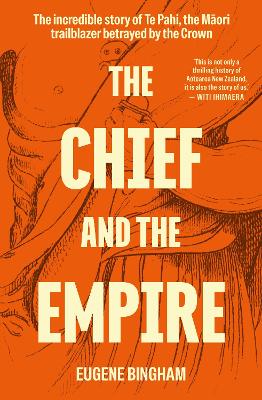
Review: The Chief and the Empire, by Eugene Bingham
'The story of Te Pahi demonstrates how history can be distorted, exposing the misunderstandings, prejudice, and imperial interests that combined to obscure the truth...'
When tupuna rangatira Te Pahi died in 1810, his influence didn’t vanish with him. ‘Threads of his legacy drifted outward like waka on the tide, carrying across the world traces of his mana, his vision, his wairua – and truths,’ writes author Eugene Bingham in The Chief and the Empire.
Two hundred and sixteen years on, this recently released book continues Te Pahi’s influence – tracing the threads of his legacy, showcasing his mana and truths, and offering up revelations for today’s world.
Billed as part history, part true-crime investigation, The Chief and the Empire brings to life an often-overlooked yet pivotal period of our past – Māori-Pākehā encounters in the pre-Te Tiriti era.
The book follows Te Pahi as he becomes the first influential Māori leader to cross the Tasman, in 1805. There, he builds close ties with the New South Wales governor, Philip Gidley King, staying at Government House for months as his honoured guest. He’s feted as a ‘rockstar rangatira’ in the 17-years-young settlement of Sydney. The first-ever state gifts are exchanged, Te Pahi receiving a kitset house and an inscribed silver medal acknowledging his chieftainship of Aotearoa New Zealand.
Rangatira ki te rangatira, diplomat to diplomat, the interactions of Te Pahi and King are marked by curiosity and mutual respect, both men eager to understand each other’s world and enhance trade relationships. But not everyone in the colourful cast of characters Te Pahi encounters is as enlightened as King. There are cross-cultural misunderstandings, and biased and racist attitudes, too, yet Te Pahi stands tall, his intelligence and humanity plain to see. One day he tells a man who mocks his mataora that his hair powder and grease is a far more absurd practice than tattooing.
An award-winning investigative journalist, author Eugene Bingham (Pākehā, Ngāpuhi) applies his meticulous research skills to every facet of Te Pahi’s legacy, one that spans from the past to the present day. He takes us on his journey to uncover previously unknown details. We’re right there with him in the NSW State Archives as he excavates 'hundreds of metres of ordered, musty-smelling muniments in manila boxes…'
But no archive is ever complete. Non-fiction writers must work with absences, silences, and gaps. In joining the disparate dots, Bingham is transparent when details are murky, conflicting accounts exists, or if conjecture is employed. His commentary allows the reader to feel included in the quest for truth.
Engagingly written, it’s impossible to overstate just how much happens in this tale of kinship and kidnappings, manaakitanga and massacres. An attempt by Te Pahi to repeal the death sentences of men accused of stealing food has an extraordinary sequel when two families and cultures reunite, in 2025. In fact, Te Pahi’s timeless story has so many layers and downstream effects, Bingham has created a trifecta of companion works, a podcast and a RNZ documentary complementing the book.
Being Ngāpuhi himself, like Te Pahi, the author is well-placed to research this story, bringing mātauranga and connection. He draws on stories of Te Pahi’s uri, descendants who have always remembered him in kōrero tuku iho, in stories handed down. There are also extensive European records documenting early encounters with Te Pahi. While these were invaluable, Bingham acknowledges: '…it pays to be cautious … those taking the records viewed him through their own understanding of the world, their own perceptions and morality…' Morality, as we sometimes observe, that can be disturbing.
The story of Te Pahi demonstrates how history can be distorted, exposing the misunderstandings, prejudice, and imperial interests that combined to obscure the truth for generations. Te Pahi’s reputation was destroyed after he was wrongly blamed for the infamous Boyd incident, leading to devastating consequences for both him and his people. Despite the tragic end to his life and the trampling of his mana, Te Pahi’s influence on generations endured. 'It was there in the diplomacy of his descendants, in the gatherings at Waitangi just across the water from his pā, and in every conversation about sovereignty that still shapes this land today,' Bingham writes.
The Chief and the Empire gives us the genesis of conversations between Māori and the Crown that continue to this day – providing context and clues for the way forward. Te Pahi’s descendants have long drawn inspiration from him. In bringing the truth about his life to a wider audience, more people will have the opportunity to contemplate his legacy.
In a moving final mihi to Te Pahi, Bingham writes: ‘...it is time for you to rest. Your uri have picked up the mantle, they walk the path you laid. E te rangatira, moe mai rā, moe mai rā, okioki mai rā.”