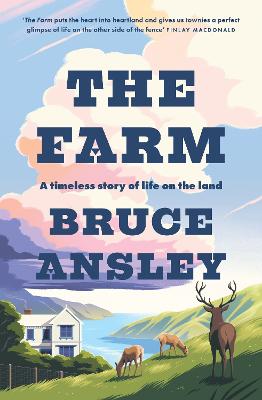
Review: The Farm, by Bruce Ansley
David Hill reports on town-to-rural memoir THE FARM.
Picture this. Bruce Ansley is a respected journalist, historian, travel writer, South Island man-on-the-spot for the Listener. He and wife Sally have a pleasant life, with a pleasant home high up in Christchurch's Sumner. So what do they do? They buy a farm.
It's one that Ansley hears about from his mate and sheep farmer Flynn, at Port Levy (named after an ex-crim) on Banks Peninsula. It's accessible only by a twisting, staggering road that makes visitors blanch when they drive it. It comes with plunging contours, a two-storey, hard-to-heat Victorian homestead, and a TB-prone, hard-to-handle herd of deer. Bruce has only minimal experience in farming. So of course they have to buy it. And of course he has to write about it, in this engaging, clear-eyed memoir.
Actually, our author did already know a bit about rural life. He'd done school holiday work on one ('all I got was sunburn'). He'd spent Edenesque times at his Dad's best mate's place. His first journalism job was in Waipukurau, for The Central Hawkes Bay Press, where he came to love the smell of woolsheds, but not their owners, who doubled as the local squirearchy.
Anyway, he and Sally and family move onto their thirty-something hectares of uneven contours, while removal men moan about the new home's stairs. He has a perfect, pellucid first morning on the place. After that, things follow the shape of the farm's contours.
The narrative steps cleanly, briskly, through a thigh-high encounter with a stag, eggs fresh from the chooks, the geological history of the peninsula, the picaresque history of escaped POW Count Felix von Lucknow, Ansley's dislike of Rogernomics and of the council's decree on Port Levy's public toilets.
He tells us of all the ills that cervine flesh is heir to. Some of his animals die, and he feels sick. Hay-baling becomes an epic and a paradigm of neighbourhood support. A guest swims with dolphins. The farm's walnuts and tomatoes yield in abundance. The author comes to term with the local eccentrics, the local community group, and the local home brew.
So there are plenty of positive, even idyllic episodes. And plenty of intriguing individuals: Flynn who yells at his human helpers to 'get in behind!'; 80-ish Peg with the terminal scar; Blackie the toast-and-Marmite-fancying sheep.
But it's also a narrative deepened by more sombre moments. There's mild racism, generations-deep conservatism, the human departures and arrivals which mean that 'the bay's delicate sociology is weakening', with its cosy infrastructure under siege. The book doesn't end as you might expect, and that's one of its strengths.
It's structured and written confidently, lucidly. Of course it is – Bruce Ansley has worked with words for decades, and he knows how to condense an anecdote, evoke a place or a person, contrast moods, show and not tell. A no-bullshit voice speaks to you.
He's got a journalist's facility with condensed and memorable specifics. You hear why his hay mower is called a UFO. Murderers-in-Waiting Pauline Parker and Juliet Hulme have a cameo part. So do Muldoon the mad stag, and Simon the Banks Peninsula Garden Tour guide, who catches one local at an unexpectedly informal moment.
It doesn't romanticise, at least not without acknowledging it's doing so. It issues the appropriate caveats: 'the grass was greener, but you had to watch where you stepped.' It digresses occasionally but quickly returns to its primary narrative. It keeps a neat balance on such seismic controversies as the No Smoking ban at the settlement's ex-school building.
A nicely nuanced, respectful and unsentimental account of two people (because Sally is always there as support and companion) hoping, working, tripping up and moving on. Bruce, from my suburban side street where the only natural hazards are kererū eating the magnolia buds, I salute you.