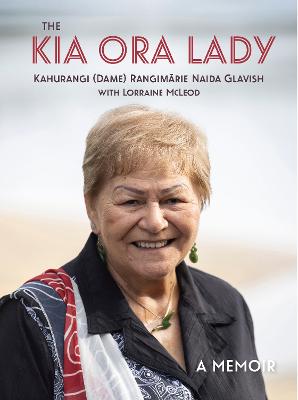
Review: The Kia Ora Lady, by Kahurangi (Dame) Rangimārie Naida Glavish
'Accordingly, whenever Glavish sees injustice, she always steps up and takes action...'
Words have guided the course of Kahurangi Rangimārie Naida Glavish’s life. From two she famously said as a young woman, to sixteen she lives by:
‘Inā kite koe i tētahi mea hē, hakatikangia. Inā kore ka rite koe ki taua hē.’
First spoken by Māmā – the beloved grandmother who raised Glavish in a nīkau whare on the edge of the Kaipara Harbour – the phrase means: 'If you see
something wrong in front of you, then you are duty-bound to correct it, because if you don’t, you will become like it.'
Accordingly, whenever Glavish sees injustice, she always steps up and takes action. The first time she was called to step up, she ended up on the front page of the newspaper. The year was 1984 and New Zealand was a rather different place. Long distance phone calls required the assistance of a toll operator. Poi E was on its way to becoming the biggest selling song of the year. Yet te reo Māori was not yet an official language.
Working as a toll operator at the time, Glavish answered calls with: 'Kia ora, tolls here.' One day a new supervisor decreed that operators could only answer in English. A battle of wills ensued. Driving to work over the harbour bridge some weeks on, Glavish contemplated whether she should ease up on her supervisor. But at the top of the bridge, she heard her late grandmother’s voice in her ear: ‘Nui ake tēnei take i a koe’. (This is far greater than just you).
Soon afterwards, the kia ora story erupted in the media, even the BBC covering it. Everyone had an opinion. Prime Minister Robert Muldoon weighed in. The Postmaster-General and others claimed that if te reo Māori was used by a toll operator, other ethnic groups would use their own greetings too. It wasn’t yet widely appreciated that te reo Māori is indigenous to Aotearoa New Zealand and a taonga the Crown is obliged to protect under Te Tiriti.
Fortunately, a negative public backlash saw the Postmaster-General’s te reo ban reversed. After that, not only did Glavish and her colleagues answer kia ora, but Kiwis everywhere began using te reo words more regularly. For Glavish, the kia ora incident opened the door to a host of new horizons, across politics, education, justice, health, and iwi governance.
From one chapter to the next, as Glavish’s life evolves, we glimpse the phenomenal range of work she went on to perform – from te reo teacher to chief Māori advisor for Health New Zealand to president of the Māori Party to Oranga Tamariki ministerial advisory board member and so much more. The golden thread connecting her multifaceted mahi is the integration of Māori cultural values and tikanga into public institutions.
Of Ngāti Whātua and Croatian descent, it’s clear from Glavish’s anecdotes just how doggedly she fights for justice. Undeterred in the face of an obstacle, she meets every challenge head-on. In recent years, while sitting next to the then-mayor of Whangārei, someone addressed the pair as 'Her Worship and Her Warship'. Glavish thought it rather apt. 'It was probably an accurate call, and much enjoyed by the audience,' she writes in her memoir.
Much like her career, Glavish’s formative years were highly eventful. Beginning life at one with nature – 'there is no better university than the environment in which we live' – 5-year-old Glavish was wholly unprepared for the family’s move to South Auckland.
'Pukekohe was a racist place in which to live in the 1950s and 1960s. At that time, Māori were segregated from Pākehā, forced to walk only on one side of the main street, and were restricted to making purchases in only some shops. Two barber shops refused to cut Māori hair, and Māori were not allowed to use public toilets.'
Frequently strapped for speaking te reo Māori at school, life deteriorated even further when Glavish was ripped away from her whānau at the age of 12 and made a ward of the state without due cause. Miraculously she prevailed, despite the adversity of her childhood, putting all she learned along the way into her kete.
A fascinating read for Māori and non-Māori alike, The Kia Ora Lady goes beyond the life of a trailblazing wāhine toa – offering up thought-provoking insights into te ao Māori. Tikanga is the basis for all that Glavish shares. Often translated as protocols or cultural practices, the heart of tikanga is about so much more, she explains. 'From human beings and plants, to the oceans and the rocks … tikanga is all about alignment of the visible and invisible elements of life.'
Glavish illuminates vast differences between the beliefs and understandings of Māori and Pākehā. Co-author Dr Lorraine McLeod notes in the acknowledgements: 'I was particularly humbled to be told of the complexity of things Māori that, as a Pākehā, I had not yet been fully exposed to.' Many readers may feel the same.
In sharing her story, Glavish identifies not as an individual, but as part of a wider collective. She wants readers to know that hers is the story of a whānau, a hapū, an iwi and a people.
Having dedicated her memoir to Māmā – 'who taught me all I know' – Glavish returns to her grandmother in closing her story: 'And every day I treasure my blessed upbringing with Māmā,' she concludes.
No doubt Māmā would be more than satisfied with her mokopuna’s indefatigable commitment to tikanga.