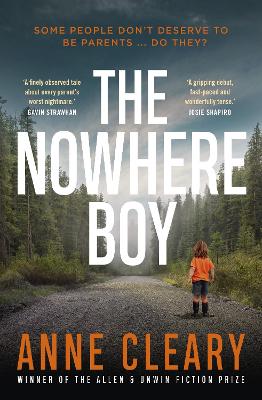
Review: The Nowhere Boy, by Anne Cleary
Claire Williamson analyses the questions at the heart of Allen & Unwin Fiction Prize Winner novel THE NOWHERE BOY.
Who deserves to be parents?
That’s the loaded question at the centre of The Nowhere Boy, Tauranga-based writer Anne Cleary’s debut novel and Allen & Unwin Fiction Prize 2025 winner.
Scott and Fae had their son, Oliver – better-known by his nickname, Apple Man – arguably too young. One weekend, Scott leaves Apple Man asleep in the car while off fishing in rural Muriwai. When he gets back, Apple Man has vanished – every parent’s worst nightmare. In their grief and desperation, Scott and Fae are dragged back together in a frantic police-led search for answers about what happened to their son.
What Scott and Fae don’t know is that Apple Man isn’t far. Driving past Apple Man alone in the car, Tessa convinces herself the boy would be far better off with her than someone who’d abandon him in a car – a clear gift from the universe to become the mother she’d always deserved to be.
The Nowhere Boy is the second thriller to win the prize, the first being Gavin Strawhan’s 2024 crime novel, The Call. In The Nowhere Boy, however, the novel hinges not on who kidnapped Apple Man but on how his disappearance impacts Scott and Fae and their respectively dysfunctional families. They circle each other warily, mutual guilt and a temporary cease fire of cooperation warring with fury and sparks of attraction.
Flashbacks reveal the extent of their tumultuous relationship. 'They’d tried to live together and be a couple. It hadn’t worked. Every piddly disagreement turned in to a full-on rumble. You couldn’t look at her the wrong way. Then there came the episode with the TV. She attacked it with a hammer.' Though tenuously co-parenting, Scott and Fae are deeply flawed and, occasionally, distinctly unlikable. But they each adore Apple Man, feeling his disappearance keenly – do the benefits of love outweigh the mistakes of youth?
Meanwhile, Tessa struggles to adapt to the realities of caring for a three-year-old toddler. Her desperation to have a child of her – to be seen as a good parent – slowly drives her to extreme rationalisations for why she did the right thing by Apple Man and how to keep him hidden from the community-wide search.
'Whoever abandoned the boy should be the one to pay. What kind of justice system hands a child back to parents who clearly can’t care for their offspring?' she insists to herself. Cleary draws no obvious conclusions for the reader about a correct answer.
The Nowhere Boy has a gripping start. But the middle, Fae and Scott each cycling through a series of poor choices, is a bit less tightly paced, and as the reader already knows what has happened to Apple Man, it perhaps lacks a bit of needed tension. Still, as the search radius expands and the Police focus on the smallest of clues, Tessa’s convoluted logic drives her toward a climactic choice that makes for a page-turning ending.
For fans of family drama with an edge of social commentary, The Nowhere Boy is a commendable debut.