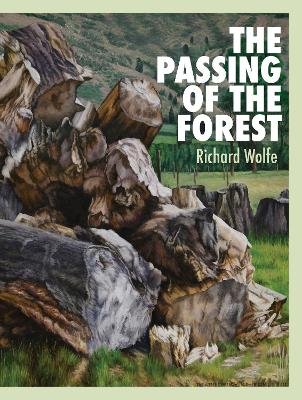
Review: The Passing of the Forest, by Richard Wolfe
Alex Eagles-Tully is inspired by this 'ode to the ngahere of New Zealand'.
The Passing of the Forest is an ode to the ngahere of New Zealand, but it is not just a lament. In this book, Richard Wolfe blends geology, palaeontology, botany, biology, climatology, history, poetry and art to explain and illustrate the whys and wherefores of the forests of Aotearoa.
Wolfe is no stranger to writing about natural New Zealand and about art. The prolific writer has authored or co-authored some 40 books including five children’s books, illustrated by his artist wife, Pamela. Other titles include Footprints on the Land: How humans changed New Zealand, Kiwi: A Curious Case of National Identity and Art New Zealand.
The original The Passing of the Forest, which inspired this book, is a poem by William Pember Reeves, with opening lines that sum up Wolfe’s topic in a stanza.
All glory cannot vanish from the hills,
Their strength remains, their stature of command,
Their flush of colour when calm evening stills
Day’s clamour, and the sea-breeze cools the land.
Refreshed when rain-clouds swell a thousand rills,
Ancient of days in green old age they stand
In grandeur that can never know decay,
Though from their flanks men strip the wood away.
There have been many books about New Zealand native forest flora, but what sets this edition apart is the artwork used to illustrate the themes. Wolfe, who has a degree from the Elam School of Fine Arts and a doctorate in art history, has sourced more than 50 paintings from over 30 artists, dating from the 1800s to the present day, depicting landscapes from Aotearoa. Among the impressive list of artists included are Doris Lusk, Dennis Knight Turner, Emily Karaka, Robyn Litchfield, and Dick Frizzell.
The book begins by explaining how, when the Earth’s youngest continent Zealandia moved south during continental drift, it took with it a rich cargo of plants and animals, dubbed ‘Moa’s Ark’ by scientist David Bellamy. This isolation meant that, for millions of years, New Zealand's flora and fauna were left undisturbed. Plant fossil evidence from India, South America, Antarctica, and Aotearoa links the flora of these continents and suggests that our native plants are among the most ancient in the world.
While human settlement and subsequent deforestation began in other countries like Australia 50,000 years ago, in New Zealand it was a mere 800 years. Wolfe notes that carbon dating of ancient forest remains indicated that around half of the ngahere that cloaked Aotearoa had vanished 200 years after the arrival of the Māori.
Early European explorers described the New Zealand forest in terms ranging from ‘pretty groves of tall trees’ to ‘the rude unimproved state of nature’. Sadly, the latter is how the British, who began to colonise Aotearoa in earnest after 1853, viewed the native flora. Early paintings by Nicholas Chevalier, Alfred Sharpe, and Francis Dillon Bell depict the kind of beautiful lush bush these early settlers would have encountered. However, paintings by Charles Heaphy, George E. Pruden, and William Strutt portraying the deforestation, including an extraordinary piece by Edwyn Temple capturing the devastation of a bush fire.
The book includes chapters on conservation and changing attitudes and credits Sir Julius Vogel with beginning the first conservation legislation in 1874, which finally passed in 1885. Paintings from this period, which adorn the accompanying pages, include John B.C. Hoyte’s Akaroa Harbour and Kennett Watkins’ Haunt of the Moa.
The chapter devoted to the mighty kauri tree is enhanced with paintings by Charles Blomfield that superbly illustrate the grandeur of these trees. Other chapters discuss the impact of exotic plant imports, including Pinus radiata; a brief history of landscape painting in New Zealand; the importance of plants to human survival; and the changing climate. Wolfe attributes ‘the first significant science-based connection’ between deforestation and local climate change to Alexander von Humboldt and details how this information helped the conservation cause in both Australia and Aotearoa.
Although much of the text and accompanying artwork in this book focuses on the damage that has befallen New Zealand's flora, the author concludes that ongoing conservation of existing forests and replanting across the nation are key to restoring the forest cloak that once adorned Aotearoa.