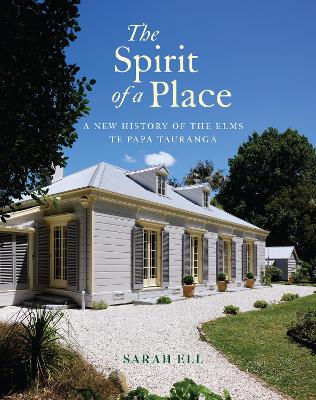
Review: The Spirit of a Place, by Sarah Ell
'The narratives of any home always appeal more than descriptions of it, and THE SPIRIT OF A PLACE offers an abundance of events, crises, anecdotes, even jokes...'
Just about anyone who has driven around Tauranga will have passed by or stopped at The Elms Te Papa Tauranga. On its appropriately named Mission Street site originally overlooking the harbour, the grouping of Victorian buildings now peeks through soaring trees at a busy, unromantic expanse of motorway and light industry.
Compared to the historic homes of Europe or Asia, New Zealand houses – Pākehā ones, at any rate – have pretty brief pasts. But in this handsome (well done, designer Kate Barraclough) and comprehensive book, Sarah Ell shows how six centuries of human occupation mark the place where The Elms Te Papa stands.
The present home and its fringe of other structures have been farmhouse, mission house, family centre. Far earlier than that, the land was settled by 13th century Polynesian voyagers arriving in their waka. Through oral tradition, letters, journals, histories of all sorts, Ell outlines the multiple manifestations of the place over 600 years. In doing so, she presents it and its peoples as a microcosm of Aotearoa New Zealand';s shape-shifting past.
The narratives of any home always appeal more than descriptions of it, and The Spirit of A Place offers an abundance of events, crises, anecdotes, even jokes. From Māori legend, we move to inter-tribal conflict and musket wars, local signings of Te Tiriti o Waitangi, the London-based Church Missionary Society to whose envoys the present buildings owe their origins. We even get a photo of early cleric Alfred Nesbit Brown's satin-covered top hat, which he's seen wearing as he helps reconcile warring iwi, who in the 1850s engraving look unsettlingly like a fusion of Inca and Australian aboriginals.
We move via cultural clashes and the Land Wars, including a powerful, poignant account of the battle at Pukehinahina Gate Pā, through the growth of present buildings, with some truly alarming early colour schemes (purple and white, anyone?), and a little free-standing library of 1838 whose multi-coloured shelves and secret trapdoor will set any bibliophile salivating.
Generations of the Maxwell family then take us up to the establishment of the Elms Foundation, the opening of the Heritage Garden, Te Tiriti Settlements, apologies for confiscations from the Anglican Church. And that's a summary so perfunctory, I feel I should apologise to the author.
There's effective and often entertaining inclusion of sidebar articles: 'Significant Baptisms/Domestic Servants/Fire at The Elms/Bees and Honey.' We hear about the first 3-act play written and performed in Tauranga. As I say, abundant narratives.
Ell frequently and appropriately references Māori presence and issues, from the opening mihi and legend of the indulged young woman who became a taniwha, through leaders warlike or Christian to contemporary scholars and artists. She's ensured that mana whenua have been part of the book's making.
There's equally apposite mention of the many women who kept the home fires burning, the children coming, the house functioning, the pa fortified. Note Alfred Brown's wives and daughters, nurses and helpers such as Marama Rangiwhakau, a pair of female Maxwells in rather idiosyncratic bee-keepers' veils.
Amanda Aitken's photographs complement and illuminate the text. There are scores of them: bright, attentive images of interiors and exteriors, often rich with sunlight. I'm a fan for the two-century-old Noah's Ark and bestiary; the Heritage Garden's multi-ribbed pavilion, the Māori taonga, the lean, clean sweep of staircase in a central vestibule.
Numerous older paintings or sepia photos also feature, including landscapes and portraits by John Kinder and Henry Williams. I must mention artist Horatio Rabley; you have to love those reverberant Victorian names. And don't miss the massed beards of the 68th Durham Light Infantry Regiment.
Sarah Ell has been writing fiction and non-fiction for decades. Inevitably, some sections here become a rollcall of names, dates, organisations, but she always manages to build engaging narratives around them. She writes lucidly, evocatively, with sustained respect for the place and the generations of people associated with it.
The Elms Te Papa Tauranga 'remains a living thing, loved and appreciated,' she says in her Afterword. This scrupulous history can now form a satisfying part of that life.