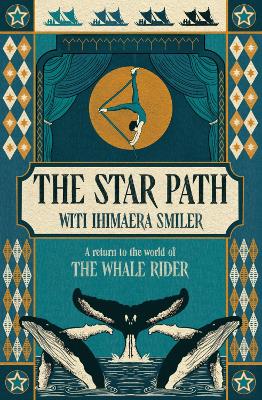
Review: THE STAR PATH, by Witi Ihimaera
Barbara Uini travels to new, broader territory in this sequel to THE WHALE RIDER.
In his latest novel The Star Path, acclaimed author Witi Ihimaera Smiler returns readers to the world first introduced in The Whale Rider. Once again, he weaves a story steeped in ancient myth, intertwining the fates of humans, whales and gods, building on the legend of Kahutia te Rangi, the original whale rider of Pasifika myth.
Both novels follow a young person striving to be accepted by their elders as they step into their unique destinies. Each examines themes of identity and belonging while probing at the raw edges where intergenerational beliefs collide. While The Whale Rider was set within the shores of Aotearoa and the Whāngārā community, The Star Path broadens this scope, sweeping readers from France to French Polynesia to Aotearoa, and finally into the inhospitable waters of Antarctica. In doing so, it explores the interconnectedness of Pasifika myth and the navigational knowledge of voyaging ancestors who travelled the vast Pacific Ocean guided by stars and sea.
Sixteen-year-old Teva is of mixed French and Polynesian heritage, raised in France with little connection to his father’s homeland of Rurutu in French Polynesia. Adept at hiding in shadows, with a curved back and strange scars, Teva longs to be somewhere else, and someone else. With his exceptional athletic talent, Teva is discovered by circus master Jean‑Luc, who becomes an unofficial guardian, accompanying him to Rurutu where Teva begins to build a tentative relationship with renowned navigator Tupai, his emotionally distant grandfather.. When Teva is drawn into a perilous mission to save the royal Mysticeti whale tribe, he is forced to confront his fears and limitations in what becomes a journey of self‑discovery and cultural awakening.
The realm of the Mysticeti whales is one of the novel’s most engaging elements. Rich with ancient lore and inherited knowledge of undersea terrain and pathways, it is populated by a lively cast including Tehani, the young hero determined to complete a seemingly impossible mission; Ti’a‑ari’i, the strong and spirited queen; and Metura’a, the incredibly ancient king of the Mysticeti. The whales’ courage and their care and loyalty towards one another gives the story emotional weight and draws readers into their world.
A true strength of The Star Path is Ihimaera Smiler’s showcasing of culture and history, touching on the deep knowledge of ancient Pasifika navigators handed down, and the close relationship between the natural world and myth. Several secondary characters, including Piwaka, the young tohunga, introduce Teva to cultural practices, such as offering traditional karakia for the journey. They recount older stories in a way that feels unforced, reflective of the way these stories were traditionally passed down orally. The use of multiple languages – English, te reo Māori, Rurutu, French, and the language of the whales – adds further depth. Many passages are left untranslated, with Ihimaera Smiler encouraging readers to ‘find meaning through context, rhythm, and repetition.’ The languages sit as an integral and accessible part of the narrative.
The Star Path is an epic journey featuring a memorable and engaging protagonist in Teva, whose physical voyage becomes a springboard for a satisfying character arc of personal growth and a developing connection to his cultural heritage and destiny. This absorbing read is bound to delight fans of The Whale Rider with its interweaving of myth, ancient knowledge and the concerns of contemporary characters, set amongst the richly imagined whale world.