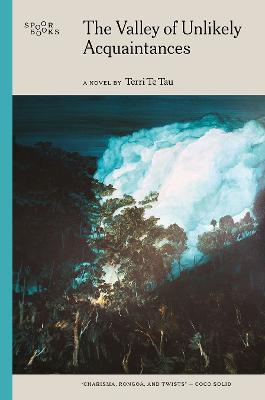
Review: The Valley of Unlikely Acquaintances, by Terri Te Tau
Mairātea Mohi surveys the wide vista of Terri Te Tau's debut novel.
Protocol dictates that tikanga may mould itself to fit the environment, the situation or the occasion that’s demanded of it. Each new era brings with it fresh conundrums and uncharted territories. And navigating a modern iteration of ethical riddles is Terri Te Tau (Ngāti Kahungunu, Rangitāne ki Wairarapa) who dives headfirst into gene editing and its implications for whakapapa in her bold debut, The Valley of Unlikely Acquaintances.
The story follows those who have called the Wairarapa ngahere home, from the early civilisations of the 1800s to an alternate near future. In this version of Aotearoa, the ratification of the 2020 cannabis referendum fuels a blossoming biotech industry. This economic shift enables the creation of a hapū-led facility, the Kōpuaranga Research Centre, and the reader is introduced to this close-knit community as they navigate de-extinction, horizontal gene-editing, and the changing tides of tikanga. But when human remains are found in a nearby cave, local speculation spirals, unravelling a troubling revelation that dates back to Aotearoa before the signing of He Whakaputanga.
Te Tau paints her fictional world with a deft hand, no doubt honed from her many years as a member of the Mataaho art collective. The book opens to a moody, mucky and mystifying scene in the forest, which solidifies the ngahere as no mere backdrop but a central character in itself. The forest evolves and moves with time, bearing the scars of human intervention,from the harakeke trade to deforestation efforts.
Yet beneath this canopy, human nature remains the same. Te Tau grounds her high-concept mystery in the everyday rhythm of small town Māori living, weaving together a vibrant core cast of Tīria, Mele, Lydia, Awanui, and the time-traveling Oreo — all with the universal realities of whānau life. Whether in the 1800s or an alternate near future, the author’s sharp social observational style captures the same enduring community dynamics: multi-tasking aunties, energetic tamariki, and cousins constantly probing the edges of the collective.
This interplay of science and tradition finds its central message in the fictional hybrid bird, the kōhuia. Beyond its role as a high-concept sci-fi element, the kōhuia serves as an allegory for cultural survival and the Māori language. An anatomical anomaly that is neither pure kōkako nor pure huia, it embodies the experience of carrying multiple lines of whakapapa. A reflection on how identity and tikanga can transform, hybridise and adapt through generations. It brings to mind Tītimoti Kāretu’s call to action, kia rere te reo, to let the language fly. Even though the language, much like this bird, has not always enjoyed clear skies.
It’s through these very transformations that fiction, in Te Tau’s hands, comes to operate like the open forum of a marae hui. Free from actual domestic crossfire, the novel zeroes in on a central ethical tension: does gene editing compromise the integrity of whakapapa, or is it simply another tool for adaptation?
My initial instinct was to resist this premise, yet Te Tau skillfully anchors her argument across multiple traditions of knowledge. She draws on pūrākau, noting that foundational figures like Tāne and Māui were themselves original manipulators of natural form, and aligns this with basic scientific logic by pointing out that everyday staples like broccoli and cabbage share the same brassica ancestry. By grounding these ethics in local plant cultivation, she shows that Māori have long engaged in deliberate selection to sustain ourselves. It’s a synthesis that makes reaching a final verdict on the question far more challenging, yet infinitely more informed.
Reading The Valley of Unlikely Acquaintances feels like setting off on a multi-day pack hike. At just over 300 pages, the pacing at times demands a back-breaking climb up a high saddle as readers process the mechanics of time travel. Other sections offer a gentler, meandering journey through moss and lichen, occasionally slowed by layered prose. Yet once you make camp, the vista opens up and Te Tau’s overarching vision reveals a landscape that marks the start of an undoubtedly brilliant career in writing.