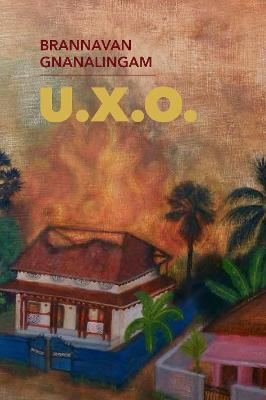
Review: U.X.O, by Brannavan Gnanalingam
'But such is the nature of memory: sometimes sketchy; sometimes selective; sometimes, as in U.X.O., continually revised...'
‘U.X.O.’ stands for ‘unexploded ordnance’, a military weapon or device that was deployed but failed to detonate — remaining live and volatile decades later, threatening at any moment to rip up our foundations.
Brannavan Gnanalingam’s latest novel revolves around an explosive history, following an Indian Tamil man describing his time as a soldier in the Sri Lankan civil war to his Kiwi grandson. From 1987 to 1990, our unnamed narrator served in the Indian Peace Keeping Force (IPKF), sent to Sri Lanka to oversee a ceasefire between the government and Tamil militant groups, particularly the Liberation Tigers of Tamil Eelam. The brutality of the conflict and the chaos and confusion of the IPKF’s role rapidly become clear, as he chronicles their mounting alienation at playing peace keepers 'deep within enemy lines':
'We stopped talking about the Tamils in Sri Lanka as people to be saved, but movable objects to be wary
of. … We were still confused as to what long-term success meant. Peace and freedom for us from being
blown up, sure, but we didn’t want to think too hard what the terms of that peace were.'
As it happened, the IPKF’s supposedly ‘peaceful’ mission caused the deaths and disappearances of many Sri Lankan civilians, including in the October 1987 Jaffna Hospital massacre and in Anaikoddai the same month (in which two of Gnanalingam’s own relatives were murdered, as noted in the novel’s dedication). Despite being dubbed ‘India’s Vietnam’, this period of IPKF intervention 'disappeared from the popular memory', possibly because, as the narrator claims, 'we had tried, but we didn’t know what we were doing.' Indian soldiers 'simply dissolved back into the mass of people at home'. Their victims, we can infer, simply became sad statistics.
But such is the nature of memory: sometimes sketchy; sometimes selective; sometimes, as in U.X.O., continually revised. The novel takes the form of a series of “drafts” penned by the narrator to his grandson, each amending, contradicting or elaborating on the last. The reliability of the narrator’s seemingly matter-of-fact account is thus immediately thrown into question. This is perhaps best shown by how, in a haunting twist, the death of the same fellow soldier occurs over and over. While I might have wanted more linearity and potentially more time with the narrator’s present day life and family, the relative ‘sameness’ in how this story is told — through trapping us in a past largely played on loop — is precisely the point. As the novel progresses, the narrator appears more reluctant to try to wring lessons out of his experiences for his young grandson, landing on a moral about fallibility and moving forward:
'… Life doesn’t work in easy, linear lines. It jolts around, and little moments, or mistakes at one point, can
reshape a life ten, twenty years later. It pays not to worry too much about things. Enjoy life for what it
gives you, and don’t dwell on what it takes away from you.'
But whose role is it to attempt to make meaning of tragedy? Intriguing as U.X.O.’s form is, and as necessary as it is in bringing to the page a history not discussed in Aotearoa, for me it is the searing final chapter that makes this novel. I always admire a writer willing to leave a reader disturbed and interrogating their own role, and possible complicity, in the work they have just read. In a conclusion both cathartic and uncomfortable, U.X.O. jolts us into a different perspective (I will avoid spoiling whose perspective, and what exactly that perspective is). What we are left with are complicated questions about how to reckon with the horrors of history and what we owe to those in the present and future. Such questions are as timely as ever. As American writer William Faulkner wrote: 'The past is never dead. It’s not even past.'