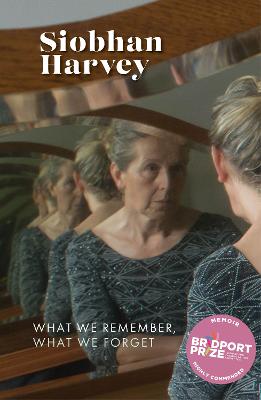
Review: What We Remember, What We Forget
'The essays develop into a sustained series of pivotal moments in the author's life and in others'. Yes, you'll think of Proust, even if you haven't read him...'
It's always intriguing when an accomplished writer moves to a new form or genre. I've known Siobhan Harvey mostly as a poet: a perceptive, precise observer of emotions and encounters. Now she's transferring those skills to essays, in this impressive, frequently affecting debut collection.
What do I want from an essay? A central motif. A narrative if possible (top essays can read like a hybrid short story). A voice that's interested as well as interesting. Reading a good essay should feel like taking part in a rewarding conversation.
Etymologically, an essay is ‘an attempt....an endeavour.’ It's a ‘Listen, I'm trying to tell you something’. Harvey tries 13 times in this collection, with substantial pieces of up to 8000 words, and some great titles: ‘When My Best Friend Came to Stay (A Minimalist Composition in Twelve Parts, After Philip Glass).’
They're all assemblages of smaller meditative, analytical or narrative sections, neatly connected by ampersands. They may remind you of photos in an album (horse-riding, or steering a charter ship). They sometimes resemble verses of an almost epic poem. They're a suite; each is self-sufficient, but the sequence builds into an overarching work.
The author's focus is overt, from the opening words of her Prologue: ‘I'm a failure. I have a long herstory of letting people down.’ Starting with a jolting account of being blamed by her miserable, damaged mother, ‘Mrs Y’, for almost dying at the age of 18 months, the essays develop into a sustained series of pivotal moments in the author's life and in others'. Yes, you'll think of Proust, even if you haven't read him. But – and I hope she won't feel embarrassed – Siobhan Harvey is a lot less self-indulgent and a lot more accessible.
Memory here can be evasive. ‘Why, in defiance of its absence, do I contend it exists?’ It can be a catharsis; a force for reconciliation, with oneself and/or others. It can also be an aid to identity: 'Sometimes I look in the mirror to divine where I come from'.
The disparate memories Harvey evokes include those that come clawing back at her when she recalls her neurodiverse son being tormented at his school. She mentions a bully in her own workplace; an episode of writer's block when no thoughts or associations come at all. There's a moving sequence in which a fig tree helps begin a fragile healing and safety. There are moments sparked by libraries and reading. At other times, memory proves maddeningly elusive: ‘I feel incensed again, denied answers I suddenly believe I'm entitled to.’ Even when it's present, it's an ambivalent source: ‘am I stealing my life back with every word I write?’
Through these essays, the lives of four generations assemble. Events are rendered lucidly, dramatically: a school's smug dismissal of her boy's ill-treatment; her own childhood eating disorder and her parents' utter indifference; her escape as a young woman to a homeless shelter in London, still hunted by images of the beatings inflicted on her at home.
There's a physical attack – no other word will do – from Mrs Y which will make you gasp aloud. We flick to Rye, Ypres, a perfume advert, the greed-powered Auckland housing market, degrees of resolution as she and brother Ciaran confirm each other's narratives. Just occasionally, the book drifts towards family history, but Harvey always draws it back to its primary, contemplative focus.
As the essays link and complement, the figure of Harvey's son, her ‘Cloudboy’ as she endearingly calls him, the kid who begins deciphering Egyptian hieroglyphics before he's three years old, becomes a compelling and recurring motif, a presence who moves her to reflect further on herself: ‘….for how much of my life I've survived by drawing into myself, my mind, the page, the world.’
Attentive, measured prose, and that essential essay feeling of an author confiding in you, sharing with you. A searching exploration that finds clarity in chaos. Yes, I'm impressed.